The first two days of the walk from Santander to Santillana are, quite frankly, boring! The modern Camino is on tarmac for the whole of this stretch and the area around Torrelavega is heavily industrialised. It would be possible to shorten this walk by using the pavement from Oruna to Requejada, or even taking the narrow-gauge railway from Santander to Requejada!
Once Cobreces is reached there is the feeling of being on a straight road! Only a feeling mind, the Way still winds around but at least goes in a westerly direction.
Do we have a 'built in' sense of direction? I took a small compass with me and only used it a couple of times in the rain and mist, when I felt that I was heading the wrong way. And I was right both times! Certainly, when on the old track-ways I had a feeling of being on the right road. The times when I went astray were in the city of Oviedo, on diversions that stopped the waymarks halfway, and on 'pavimiento' in the pouring rain when I missed a 'mojon' (concrete marker post).
In Comillas in the rain I saw a lone peregrino looking puzzled in the main square, a young 'gap year' German called Sven. He spoke excellent English but hardly any Spanish! After a welcome 'cafe con leche' I asked a taxi driver the way out of town - easy! From there we walked some 20 kilometres together to San Vicente de la Barquera.
Once past Colombres there is a beautiful coast path (not on the ancient camino) that goes most of the way to Llanes. From Buelna through to Sebrayo is what I will for ever think of, as the 'Camino de la Costa'.
Lessons learnt early in the Camino were: -
Don't ignore your 'gut feeling'. If it feels wrong, it most probably is wrong!
Don't be afraid to ask the way. The best people are taxi drivers rather than the police. The taxi drivers know all the shortcuts, legal and illegal!
As far as possible always speak to people in their language. If they know yours they will happily practise on you, which may make them more difficult to understand.
In Christian terms this last point could be called 'Incarnational Theology'. When God wanted to communicate with the human race He didn't sit on a cloud and shout. He sent His Son born of a woman, a human being like us; speaking our language.
The things we learn about on Pilgrimage!
Thursday, 2 July 2009

Photos: Colombres to Llanes
Leaving Colombres; the snow capped mountans can be seen behind the church


A very tidy little farm near El Campo
Two cows grazing near Pendueles
The coastline all along here is stunning.


A very tidy little farm near El Campo
Two cows grazing near Pendueles
The coastline all along here is stunning.
Photos: First views of Llanes


I had to walk on the 'hard shoulder' on the road near Llanes as there was tree felling on the other side where the Way is marked.
The 'new' town centre with the old castle, which is across the harbour, in the background.
The path along the cliff.
The view from the harbour out to sea
Wednesday, 1 July 2009
Photos: Llanes (rest day)


The old town centre at Llanes. The house in the centre dates from 1200 and has a seperate kitchen building on its left.
The steps on the coast walk pass a natural cave under the cross.
At the other side of the square is the part Romanesque church of Santa María de Consejo with its ornate carved doorway
There is more about Llanes, with photos, at the posts for 2nd and 3rd May - 'Colombres to Llanes' and 'Llanes
Tuesday, 30 June 2009
Photos: Llanes to Nueva


The Way crosses the beach at Celorio.
Gentians growing by the path


The deserted monastery at San Antolin
A wild looking pig in a pen near Naves
Monday, 29 June 2009
Photos: Along the Camino Antiguo
The Picos de Europa near Nueva


Near Torriello: the Way here is known as the Camino Antiguo


Near Torriello: the Way here is known as the Camino Antiguo
Photos: Ribadesella and Camino Real
The Way leaves Ribadesella over the bridge.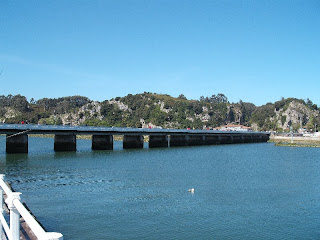
 At La Vega the Camino Real is still paved. (See blog for May 5th)

 At La Vega the Camino Real is still paved. (See blog for May 5th)
Sunday, 28 June 2009


Photos: La Isla to Villaviciosa


 The new house is between two virtual ruins at La Calzada.
The Camino Real leaves the road and goes through the woods, still paved in parts.
(See blog for 5th May)
The wayside shrine was at La Vega (the other one!) on the Camino Real
A bend in the road provided a final view of the estuary as the Way turned inland
Saturday, 27 June 2009
Photos: Villaviciosa to Pola de Siero
At Capilla San Blas the Way divides, one part goes to Gijón, the other turns left through Valdediós. The shell signs on the marker stone (on roadside at left) face the chapel.


 The maize store, on staddles to keep the rats away, has not been built under,unlike the store further on.
The largest Asturian medieval monastery, with the Abbey Church of Santa María is at Valdediós. It has been carefully restored.
Also in the monastery grounds is the church of San Salvador de Valdediós, consecrated in 893AD.
The walk from Valdediós was the first real test of my leg muscles uphill since I left Exeter and walked over Haldon (249mts). The Way rises 400mts in 3km, winding up the hillside. From the top there is a view down the 'Hidden Valley' to the monastery and the mist had gradually cleared to allow a photo back.
The brass scallop shells set in the paving slabs mark the Way in Pola de Siero and also in Oviedo
Photos: Pola de Siero to Oviedo
The large bull (toro) sign is an advert for Toro wine, seen on a number of hilltops and visible for miles around.
A maize barn in use near Fonciello. The maize is hung on the outside of the barn to dry. This must be last year's crop. Nearby the old palace at Meres can be seen over the tree tops.
Just before Oviedo, at Colloto, the road passes over the old Way over the bridge (Puente de Colloto). Built on Roman foundations it was partially destroyed during the Civil War when a number of Roman coins from the 4th and 5th centuries were found in one of the damaged arches. The bridge was later restored and remains part of the Camino.


Friday, 26 June 2009
Photos: Oviedo - old and new buildings
Parts of the church of San Tirso el Real date from the time of Alfonso 11 (791-842). The triple arch window is original. A the front of the building there is a Roman soldier standing in a niche.
Modern building works still preserve old walls. The scaffolding is holding up the old house front while new work takes place behind. This will eventually join the old facade.


Modern building works still preserve old walls. The scaffolding is holding up the old house front while new work takes place behind. This will eventually join the old facade.


Thursday, 25 June 2009
Photos: Oviedo to Grado
After a cloudy start, see blog for May 10th, the sun came out. The Camino follows the winding road past the apple trees near to an isolated house at Romeda. The wild flowers were further along the Way. At Peñaflor the houses overhung the road.


Photos: Grado to Salas
The Camino follows the old paved Way at El Morriendo and crosses the Rio Narcea. It passes the monstery at Cornellana and crosses the Rio Nonaya twice, at Casazorrina, before reaching Salas.


Subscribe to:
Posts (Atom)